
26 June 2015
Anthony Trevelyan on the inspiration for his new novel
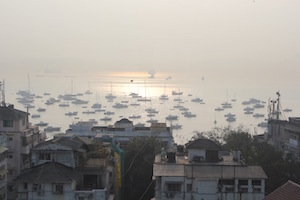
The Weightless World is about – among other things – a trip to India. Not very surprisingly, then, it has its origins in a trip to India, one I took almost exactly ten years ago, in the winter of 2005.
The trip was organised by the India Project, a charity set up in 2003 at the sixth form college in Stockport where I worked. There was talk about stuff we might do with the kids, ways to delight or distract them during activity sessions at the various schools. I got the injections and spent a few days with strange new chemicals joggling round inside me. People kept telling me how ‘intense’ I was going to find Mumbai, and ‘invasive’, and above all ‘hot’.
I wasn’t worried. A rough stack of students had already made it to the subcontinent and back without noticeable injury; surely nothing could be simpler than visiting India as part of a crack squad of omnicapable teachers.
You’d think, wouldn’t you.
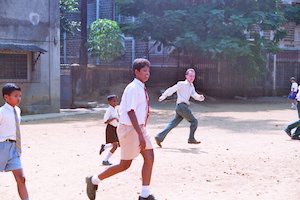
The Garden School stands beyond an alleyway off a clatteringly busy street. Children sleep bundled among shivers of paving stone. Shirtless men lean together at corners, drolly gossiping. Everywhere the traffic runs with tumultuous efficacy – it’s like peering into some antique but utterly solid engine, noisy and gnashing but getting the job done. It should be bedlam but somehow it isn’t. In ten days we see no accidents.
Then the school appears, a collection of stubby buildings opening onto a wide compound in the heart of the city. Sister Patricia, the Catholic nun who runs the Garden School, has made it her life’s work to provide aid here for Mumbai’s least fortunate children. When they come to her, the kids lack even basic hygiene. By the time they leave her they have a foundation in reading, writing and arithmetic, as well as exuberant social graces.
The children we meet on Day One are luminous. However their only English is rote English: songs and rhymes, lists and numbers. We don’t know what to do with them. We sing every song, play every game we know, and that takes about a quarter of an hour. We pass the next hour in exhausted despair, occasionally asking one of the kids if they like school, or if it’s always this sunny.
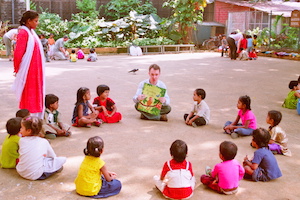
On Day Two we take a different approach. Surrounded by quizzical faces, my colleague Helen begins to read the story of Noah’s Ark. We have brought, for demonstration purposes. And I start playing with it like the most appalling showoff child you ever saw.
It is not a disaster. Helen reads the story well, finally I let the other kids play with my ark, and this turns into painting animals on big sheets of paper. Somehow this turns into painting T-shirts. It’s the same in the other groups: in the group playing with the parachute and the group reading stories and the group making badges and the group skipping rope.
“Well I think that went really well,” I say, as we’re leaving.
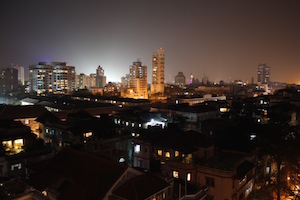
In Salman Rushdie’s novel Shalimar the Clown (2005), Maximilian Ophuls observes that “India is chaos making sense.” In Mumbai you don’t have to look for the chaos: it’s there at first glance, in the robot grapple of the traffic, in the disorderly fire-sale of each street. What emerges more subtly is the ‘making sense’ part of the formula, undeniably present and exerting its own tensions.
Cheered by our non-disaster at the Garden School, we visit St Xavier’s, the junior college of which is the Mumbai equivalent of a sixth form. The teachers we meet are weary and charming. They show us a classroom, with the tight benches and long tables. As it’s a similar size to our teaching rooms in England, we seek other comparisons and ask about numbers of students per class. The answer? 112. While we just stand there a teacher explains, “We fit them in. We make it work.” And they do: throughout India, Xavier’s enjoys a reputation to rival Harrow. The college magazine looks like a prospectus of doctoral theses.
That night we gussy up for dinner at the Oberoi, the most hair-raisingly posh restaurant on Earth. In the glassy vault of the atrium you shrink under some bodiless scrutiny: the air seems to scan you with its Fabergé sheen, to test your poshness and to find it radically wanting…In fact everyone has a very nice, swanky time.
Next morning we go to the slums. It is shattering. Beyond the city stretch many miles of conurbation improvised from bits and pieces, shreds and patches, bits of rope and cardboard and tinfoil. We enter a small school, and this is where I really lose my shit. There is nothing in my experience to accommodate these children stuffed together on the floor with smudged bits of paper in front of them. We are told that the children are ‘excited’ to see us, but there’s no way of judging this. Behind our inability to communicate with them, they seem resigned, harassed. An older boy has a pale bloom of discoloration covering his cheek and nose. He consents to be photographed. It is completely shattering.
And yet it’s here I start to feel it, the visceral screwing or clamping that tells me at some point I’m going to have to write about all this. I will take away a bellyful of hectic impressions and they will not rest in me until I turn them into…something. I don’t yet know what.
The slum looks like a disaster zone but the mood is calm. Hereabouts people get on with their lives. They are friendly, inquisitive. Kids wave to us as we climb onto our bus. Because to them the slum is life, just life, the usual chaos making sense.
There has been no disaster, unless you think the slum is a disaster.
Outside the hotel we wait for our bus. It should have been here ages ago but still hasn’t arrived. Fortunately we’ve grown used to this sort of thing, and we roll our eyes at each other and say “Bombay time” or, more properly, “Mumbai time.”
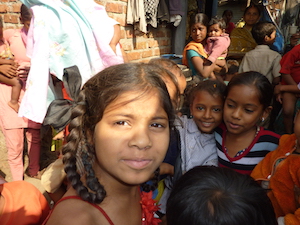
This is Mumbai time: nothing happening for ages and then everything happening at once. So there’s no bus for ages and then at once there’s the bus, the shooting city, speeding gulfs of countryside, and we’re at a girls’ hostel in Kharghar, on the city outskirts. The girls meet us cautiously. You can’t blame them. Apart from anything else, our plan for today is to stage a play for Diwali, a dramatic retelling of Rama’s return to Ayodhya. The script is written but in a day we need the girls to rehearse the drama, design the music and dances, and make all the props and backgrounds and costumes.
In the hostel’s chapel, we divide the girls into groups. Team leaders claim their share of children. Scripts are read, steps practiced, shakers shaken. I run from group to group, nominally organising. Progress gets made anyhow.
At some point we had all day for this; then there are only minutes. The set is ready. The costumed girls (bears, monkeys, demons) are ready. Then nothing happens for ages. The girl playing Sita is being tied into an elaborately folded sari, and her dressers will not be hurried. I plead with them, I beg. They will not be hurried.
Then everything happens at once: Rama’s sorrow, the army of bears and monkeys, the war with the demons, Sita’s rescue, the glorious return. The children are wonderful; they are nothing short of miraculous. With a bang, glitter showers the stage. The girls cry out, they rush forward under the fall of light. Watching, I rush forward too.
I remember the end of the rhyme we sang on Day One: “Fishes in the water…” And at once I know what I will write – or I sort of do. A book of horrors and of wonders, not quite in equal measure, and not quite in the way or for the reasons I would have imagined before I started to rush forward with the spiralling girls. A book about light and heat, about texture and massiveness, about weight and its opposite…And in the flashing air of the chapel we all jump up, one, two, three.
Share it:


Add new comment