
31 July 2014
Jonathan Gibbs, as well as a writer of one of the best of books, is also one of the best writers about books we have. Look, for instance, at this lovely thing he's just written for us about the books that influenced Randall.
He even wrote his own standfirst, so making this one hilariously redundant:
Jonathan Gibbs picks four books that influenced him, consciously and unconsciously, in the dreaming up and writing of Randall.
On the Road by Jack Kerouac
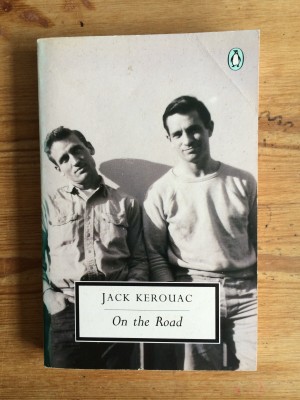
This book has developed a reputation for being wildly overrated – or perhaps just for being not as good as people remember it – but I think there's one thing it does very well: the anatomisation of a friendship. It helps that most people read it at that crucial age when 'friendship' is in mid-evolution from its childhood form – who you run around with during playtime – to its adult one, in which a shared outlook and deep emotional resonance can act as a motor through the life to come.
In the book, of course, the friendship is not equal (though what friendship is?). The narrator, Sal, hangs back, in awe of Dean Moriarty, as well he might. And, in a way this relationship echoes the act of reading itself. In books, we tag along and observe, thrilled to be caught in the slipstream of someone more fantastic and more charismatic than ourselves, someone headed either for glory or destruction, or both.
Compare and contrast to the 'odd couple' in movies, where the dynamic is portrayed from outside, and the two halves are more equitable, a sort of yin and yang. Novels are better are getting us inside the bubble of the relationship, showing us friendship through indulgent, complicit, anxious eyes. It's there in Kerouac, in Gatsby, to an extent, and continues through the years to the likes of Emma Jane Unsworth's Animals.
Though On The Road wasn't consciously in my mind during the writing of Randall, I think in retrospect it must have been an influence. The very first germs of my novel formed in a long-discarded short story about two male friends, and those two characters live on in some facets of Randall and Vincent, the anarchic anti-hero and his adoring, watchful acolyte.
Doctor Faustus by Thomas Mann
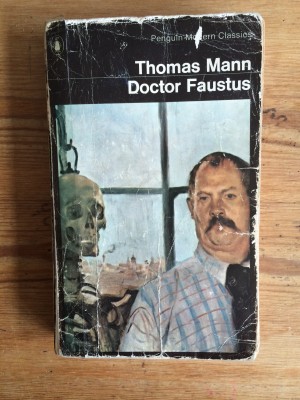
This is a more direct influence on the book. Mann's great novel is a pretend biography of the fictional composer Adrian Leverkühn, now dead, by his oldest friend, Serenus Zeitblom. The pathos of the situation is that Zeitblom – poor well-meaning, stuffy, foolish Zeitblom – knows that his dead friend was a genius; knows that he himself is a dolt; knows that his attempt to do justice to genius is doomed; knows that he must try nonetheless.
I simply took that dynamic and transposed it to Randall, the artist, and Vincent, his City boy buddy, trying to write a memoir of their time together. Having a writer-narrator who considers himself basically unequal to the task builds a delightful tension into the character's voice. All biography falters on the fallacy that we can ever really know another person; having someone who feels they're constitutionally unequal to the task only heightens this.
Another important element of Doctor Faustus is that as Zeitblom writes down his version of Leverkühn's life, he also reflects on the world around him. He is supposedly writing it during the lead-up to the Second World War (Mann wrote the book between 1943 and 1947) and I love that dualism, that awareness of how the telling of the past is affected by the present. That seeps into Randall, I think, but in different ways.
The Colour of Memory by Geoff Dyer
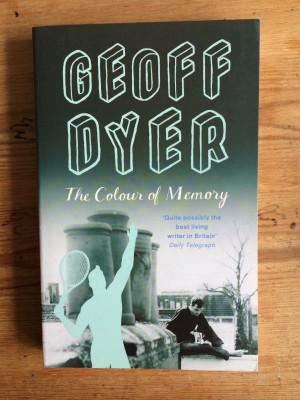
Frankly, I daren't pick this book up any more, for fear of seeing how much I've ripped it off. Bizarrely, although I'm an avid re-reader of Dyer, I don't think I'd touched this one in years – but I do know from the glimpses I've stolen of it that what I did read, when I read it the one or two times that I have, sunk in deep, and stayed, and grew.
It's the suffocating cloud of nostalgia that hangs on every page, like a cloud of dope smoke in a house party… but no, 'suffocating' isn't the right word, or not the only right word. The nostalgia breathes, too. Also, The Colour of Memory, is about a group, and about how the dynamics of friendship work within the larger ecosystem of the 'group of friends'. That, too, I took.
The last thing I nicked from it (though it's hardly Dyer's invention – though that doesn't stop me knowing that that's where I stole it from) is the way it handles its text-within-a-text. Doubtless there are all kinds of theoretical meta-this, meta-that ways of describing this, but what I loved, what I stole, was the sheer off-hand genius backhand passing shot of this, the first sentence in the book:
The pages were bathed in the yellow light of the reading lamp. I read a few phrases at random, flicked through some more pages and then turned back to the beginning and read the first sentence:
After which, of course, you turn the page, and read the first sentence.
It's not that Dyer is interested in 'the status of the text' or the 'embedded material'. It's that he knows, and loves, the act of reading. He knows that anyone reading his book, whatever else they are doing, will be reading his book. And that is something he wants to celebrate. (In passing, I know there's Calvino's If On a Winter's Night a Traveller, but what Calvino does formally, Dyer does informally, in passing.)
What I Loved by Siri Hustvedt
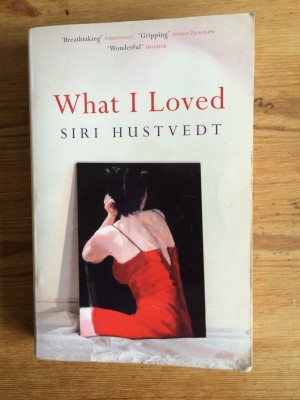
Another book that I had to put down, having read 20 or 30 pages, so disheartened I was to find that someone else had done what I was trying to do – and scared that if I read on, I would steal as mercilessly as I'd done (unconsciously) with Dyer. Or, worse, that I'd be scared off putting in something I'd been going to, because it was there already in Hustvedt.
What I Loved is a novel of two parts (she says three, but I disagree), and one great, terrific narrative shock. The opening third is a detailed, insightful memoir about friendship, and about a closed moment in personal history, and, in both of those things, about art. The art is treated admiringly, rather than, as per Zeitblom, awestruckedly; and it's treated intelligently, rather than, with Zeitblom, scared into an artificial intelligence as if afraid of admitting that his response to the work involves feeling, when all responses to artwork involve feeling. (That's what I mean about him being a dolt.)
What Hustvedt does is give the sense of a conjured up past, of made-up art made real for the reader, and through that the theory behind the art made vivid: all that I responded to, as a reader, and reacted against, as a writer… because it was achieving exactly what I was trying to do.
I put the book down, and only picked it back up once mine was finished. I was then surprised – and disappointed – and relieved – to find that the rest of the book, the second two thirds, went off somewhere else rather different, and I liked it less. But still the point stands: a novel about art, by a writer understands both art and fiction. That's what the first third of What I Loved was, and what I wanted Randall to be.
So there you have it: four steps to Randall, or perhaps Randall: the recipe.
On The Road [friendship] + Doctor Faustus [hagiography] + The Colour of Memory [nostalgia] + What I Loved [art appreciation] = Randall.


Add new comment